
Danshari: The Japanese Decluttering Secret That Cleared My Desk—and My Mental Space
Have you ever sat down to work, looked around your desk, and suddenly felt like your mind was just as messy as the space around you?
There are papers you don’t need.
Things that don’t belong there.
Objects you haven’t used for months.
Old things you keep because you might need them someday.
And somehow, before you even begin your important work, your attention is already scattered.
I experienced this myself.
My workspace was often surrounded by unnecessary things. I would sit down intending to work, but the mess around me made it harder to feel settled. Sometimes I would avoid cleaning the surface and simply try to work anyway.
Then I discovered a Japanese concept called Danshari (断捨離).
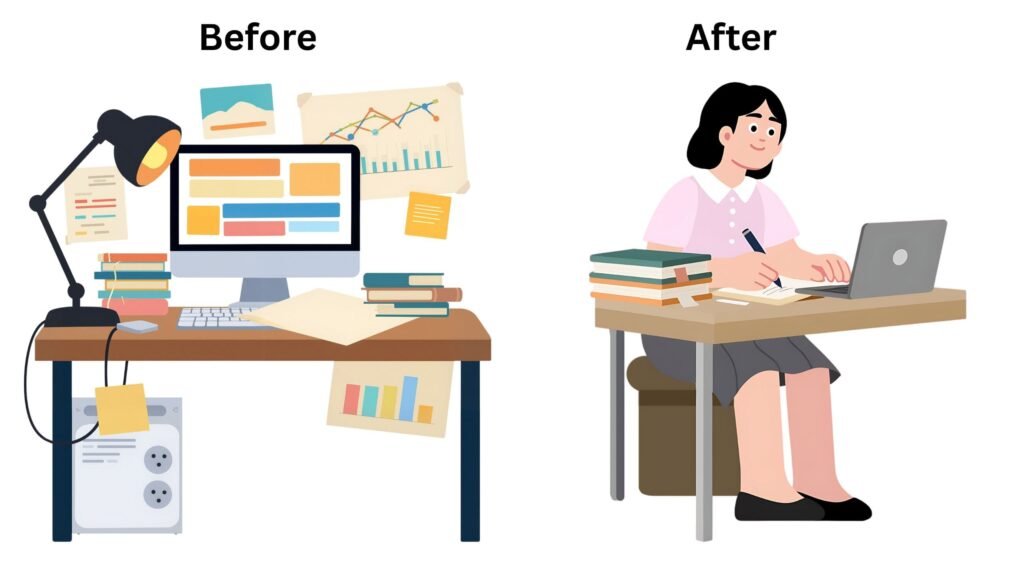
At first, I thought Danshari was simply another method of cleaning and organizing a room.
But the more I researched it, the more I realized that there was something deeper behind the idea.
Danshari is associated with letting go of unnecessary things and, more deeply, examining our attachment to possessions. Hideko Yamashita, who developed the Danshari approach, describes it as more than a tidying method: the goal is to free ourselves from unnecessary attachment to things.
That made me ask myself a simple question:
What am I still carrying that I no longer need?
And that question turned out to be much bigger than my desk.
What Is Danshari?
Danshari is a Japanese decluttering approach developed by Hideko Yamashita. Her approach became especially influential through her 2009 book Danshari: The New Tidying Technique. Academic research describes Danshari as a modern Japanese decluttering method centered on changing our relationship with possessions and reducing unnecessary attachment.
The word Danshari is commonly explained through three characters:
Dan (断) — Cut off
The idea is to refuse or cut off unnecessary things from entering your life.
Instead of constantly bringing more things into your space, you become more conscious about what you actually need.
Sha (捨) — Let go
This refers to getting rid of things that are already in your life but are no longer necessary.
This can be difficult because we often have reasons for keeping things:
“I might need it someday.”
“It was expensive.”
“Someone gave it to me.”
“I used it years ago.”
“Maybe I’ll use it again.”
Danshari challenges us to look at our current relationship with those things rather than automatically holding onto them.
Ri (離) — Detach
The deeper goal is moving away from unnecessary attachment.
Academic research on Danshari describes this as moving toward a state in which we are less attached to possessions and less controlled by them.
So Danshari isn’t simply:
“Make your room look clean.”
It asks a deeper question:
“Why am I holding onto this?”
My First Understanding of Danshari
When I first heard about Danshari, I thought it was mainly about cleaning.
I imagined a messy room, a messy cupboard, or a messy desk.
So I started thinking about a simple way to organize my own workspace.
Imagine your desk is full of things.
You could separate them into two groups.
Things I genuinely don’t need
These are things that I no longer use or need.
Instead of repeatedly moving them around, I can decide whether they should be discarded, donated, recycled, or otherwise removed responsibly.
Things that don’t belong here
These things may still be useful, but they belong somewhere else.
A book belongs on the bookshelf.
A charger belongs in its storage place.
A piece of clothing belongs in the cupboard.
The goal isn’t simply to make the desk look beautiful.
The goal is to make the desk clear and intentional.
While researching decluttering, I came across a simple two-group approach. I decided to try it on my workspace.
The first group helped me let go of things I no longer needed. The second helped me return useful things to where they actually belonged.
Remove what you don’t need. Return what you do need to its proper place. Then make space for the work that matters
Then I Started Thinking About Mental Clutter
This is where Danshari became more interesting to me.
If unnecessary things can fill our physical environment, what about the things that continuously occupy our attention?
A negative comment.
A piece of bad news.
Something someone said about us.
A mistake from yesterday.
A worry about tomorrow.
A thought we keep replaying even though we cannot change what happened.
I don’t mean that Danshari teaches us to literally “throw away” our thoughts.
It doesn’t.
But my experience with decluttering made me think about another question:
Do I really need to keep giving this my attention?
For example, imagine you see a negative comment on social media.
You cannot change the fact that the person wrote it.
You can learn something from it if there is something useful to learn.
But after that, you have a choice.
You can continue thinking about it for hours.
Or you can say:
“I have understood what happened. I’ll take the lesson if there is one, and I don’t need to carry the rest.”
For me, this is where the idea of physical decluttering can become a useful personal metaphor for mental clutter.
Not every thought should be ignored.
Some thoughts need attention.
Some problems require action.
But some things simply don’t deserve the amount of mental space we keep giving them.
I Applied Danshari to My Own Workspace
This is where the concept stopped being something I had simply researched.
My working desk was in my living room, but I preferred working in my bedroom.
So I decided to change my setup.
I moved my workspace.
Then I cleaned it.
I removed unnecessary things.
I organized the things that remained.
And I made one small decision:
This space is for work.
Before this, I would sometimes put other things on the surface and then try to work around them.
Now I wanted the desk to have a clear purpose.
Work.
That’s it.
And I noticed something.
Before, when I looked at the mess, my mind sometimes felt stuck.
I would see the clutter before I even started working.
After organizing the space, I felt more energetic when I worked.
I felt more relaxed.
Starting felt easier.
The room hadn’t magically changed my life.
But my experience showed me something important:
Sometimes removing a small amount of physical clutter can remove a small amount of mental friction.
And when you’re trying to build something, even small reductions in friction can matter.
The Morning Problem I Didn’t Notice Before
Think about a simple example.
You are getting ready for work.
You’re already late.
You need your socks.
But you can’t find them.
You search.
You become irritated.
You finally find them.
Now you’re rushing.
Your morning has already started with stress.
The socks weren’t a huge problem.
But the unnecessary disorder around them created friction at exactly the moment you didn’t need it.
The same thing can happen at your workspace.
You want to start working.
But first you have to move things.
Find things.
Organize things.
Decide where things belong.
Your actual work hasn’t even started yet.
This made me realize that organization isn’t always about appearance.
Sometimes it is about reducing unnecessary decisions and distractions.
What About Things From Your Past?
This is where Danshari became personal for me again.
I have old notebooks from around 9–10 years ago.
They contain things I learned during different periods of my life.
I explored fashion designing.
Then mandala art.
Then abacus.
And many other things.
When I look at those notebooks today, I realize that I don’t necessarily need all of the information inside them anymore.
But I still kept them.
Why?
Maybe because they represent a part of my past.
Maybe because I think:
“What if I need them someday?”
Maybe because throwing them away can feel like throwing away a small piece of the person I used to be.
And this is where I think the idea of attachment becomes interesting.
I can appreciate who I was without needing to physically keep everything that belonged to that version of me.
That doesn’t mean I have to throw everything away.
I could keep the most meaningful notebook.
I could photograph a few pages.
I could preserve a memory.
Or I could decide that it’s time to let something go.
The important part is that the decision becomes conscious.
Danshari Doesn’t Mean Throwing Everything Away
This is something I think is important to understand.
Decluttering doesn’t mean:
“If you haven’t used something recently, throw it away immediately.”
Life isn’t that simple.
Some objects have genuine practical value.
Some have emotional value.
Some are important documents.
Some are memories.
Some things may be useful in the future.
The point is not to become obsessed with owning as little as possible.
The point is to become more aware of your relationship with what you own.
Ask:
Do I use this?
Does this still serve my life?
Why am I keeping it?
Am I keeping it because I need it, or because I’m afraid to let it go?
Those questions can sometimes reveal more than the object itself.
A Simple Danshari-Inspired Experiment
You don’t need to clean your entire house.
Start with one small space.
Choose:
- Your work desk
- One drawer
- Your wardrobe
- Your cupboard
- Your computer desktop
- Your bag
- A collection of old papers
- Your phone’s unused apps
Then follow these steps.
Step 1: Look
Don’t immediately start throwing things away.
Just observe.
What is actually there?
Step 2: Decide
For each thing, ask:
Do I use this?
Do I need this?
Does it belong here?
Does it still have a meaningful place in my current life?
Step 3: Let go
If something genuinely doesn’t serve you anymore, decide how to responsibly remove it.
Donate it if someone else can use it.
Recycle it where appropriate.
Discard it when necessary.
The point is not simply throwing things into the trash.
The point is letting go intentionally.
Step 4: Give things their place
If something belongs somewhere else, put it there.
Don’t allow your workspace to become the storage place for everything.
Step 5: Observe yourself
After you’re finished, don’t just look at the clean space.
Look at yourself.
Ask:
“Do I feel different?”
Maybe you feel calmer.
Maybe nothing changes.
Maybe you realize the real problem wasn’t the clutter.
That observation is part of the process.
Don’t Turn Decluttering Into Another Form of Perfectionism
There is another trap.
You might think:
“My room needs to be completely clean before I can work.”
Then cleaning itself becomes procrastination.
You spend three hours organizing your desk instead of spending one hour doing the work that actually matters.
That’s not the goal.
You don’t need a perfect room.
You need a space that supports your current purpose.
Your desk doesn’t have to look perfect.
It needs to make it easier for you to sit down and begin.
That’s enough.
What Danshari Taught Me About Myself
Before researching Danshari, I thought decluttering was mostly about physical cleanliness.
Now I see it differently.
For me, it became an opportunity to ask:
What am I still carrying simply because I have become used to carrying it?
Sometimes it’s an object.
Sometimes it’s an old notebook.
Sometimes it’s something that belongs somewhere else.
Sometimes it’s attention that I’m giving to something I cannot change.
And sometimes it’s an old version of myself that I’m afraid to leave behind.
I don’t think the answer is to remove everything.
The answer is to become more conscious.
To decide instead of automatically keeping.
To notice instead of ignoring.
To let go when something no longer deserves its place.
Maybe We Don’t Always Need More
When we want to improve our lives, we often think about adding things.
More knowledge.
More habits.
More goals.
More productivity.
More motivation.
More things to learn.
But sometimes growth can also come from removing.
Less unnecessary clutter.
Less distraction.
Less attachment.
Less attention given to things we cannot control.
Less pressure to keep every part of our past.
And perhaps less fear of letting go.
This doesn’t mean having an empty life.
It means making room for what matters now.
Final Reflection: What Are You Still Carrying?
Danshari made me ask myself a question that I think is worth asking yourself too:
What am I still carrying that I no longer need?
Maybe it’s something on your desk.
Maybe it’s an old object.
Maybe it’s something you’ve been keeping “just in case.”
Maybe it’s an old plan.
Maybe it’s attention you’re giving to something that has already happened.
Or maybe you don’t know yet.
That’s okay.
You don’t have to remove everything today.
Start with one thing.
Look at it.
Understand why you’re holding onto it.
Then decide.
Keep it because it genuinely belongs in your life.
Move it because it belongs somewhere else.
Or let it go because its place in your life has ended.
For me, Danshari didn’t mean simply having a cleaner desk.
It helped me notice how the space around me could influence the way I entered my work.
And perhaps that’s the most useful lesson I took from it:
Sometimes making space around you can help you make space for what matters within you.
Not because a clean room magically solves your problems.
But because when unnecessary things stop demanding your attention, you may have a little more space to notice what actually deserves it.
A Small Challenge for You
Before you leave this article, choose one small space.
Not your whole house.
Not your entire life.
Just one drawer, one desk, one shelf, or one digital folder.
Ask yourself:
What is useful?
What is unnecessary?
What belongs somewhere else?
What am I holding onto only because I’m afraid to let it go?
Then make one decision.
Because self-improvement doesn’t always begin by adding something new.
Sometimes it begins with letting something go.
Related Post
- I Thought I Was Preparing. I Was Actually Overthinking – Sometimes preparation feels productive, but it can quietly become another form of overthinking. Here’s what I discovered about recognizing the difference and choosing action.
Sources & Further Reading
- Hideko Yamashita’s official Danshari website — explains Danshari as more than tidying and describes its core as letting go of attachment to things.
Note: The workspace experiment, mental-clutter reflection, and old-notebook story in this article are presented as the author’s personal experience or interpretation inspired by Danshari—not as formal steps of the Danshari method.

One Comment