Wabi-Sabi : Learning to See Beauty in What Is Imperfect, Impermanent, and Unfinished
Inspired by the Japanese philosophy of Wabi-Sabi
Have you ever wanted to start something, but kept waiting until you were good enough?
I have.
At one point, I decided that I wanted to start a YouTube channel.
I researched courses. I thought about what skills I would need. I worried about my communication, my confidence, my video editing, and whether I would be able to make good videos.
I kept telling myself, “I should learn a little more first.”
Then I will be ready.
But I never started.
I was waiting.
Waiting to become better at speaking.
Waiting to become better at editing.
Waiting to feel confident.
Waiting to feel ready.
Somewhere in my mind, I had created a condition for beginning:
First become good enough. Then begin.
But perfection kept moving further away.
The more I learned, the more I found something else I needed to improve.
Then I came across Wabi-Sabi.
At first, I thought it was simply a Japanese idea about imperfection.
But the more I learned about it, the more I started seeing it in my own life.
Wabi-Sabi is connected with finding beauty in imperfection, impermanence, simplicity, age, and things that are unfinished or changing.
And I started asking myself:
What if life doesn’t have to be perfect to be meaningful?
Maybe I Don’t Need to Be Perfect Before I Start (Imperfection)
My YouTube story is probably the easiest place where I can see this in my own life.
I was treating imperfection as a reason not to begin.
I thought my first video needed to be good.
My communication needed to be polished.
My editing needed to look professional.
My confidence needed to come first.
But when I think about it now, why should my first attempt look like the work of someone who has already spent years doing it?
My first video can simply be my first video.
It can have mistakes.
I can feel nervous.
I can improve after doing it.
This doesn’t mean I shouldn’t improve myself.
It doesn’t mean poor work is automatically beautiful.
It simply means that being unfinished doesn’t mean being worthless.
I don’t need to become the finished version of myself before I begin.
Maybe I just need to begin with the version of me that exists today.
An imperfect beginning is still a beginning.
Everything Changes (Impermanence)
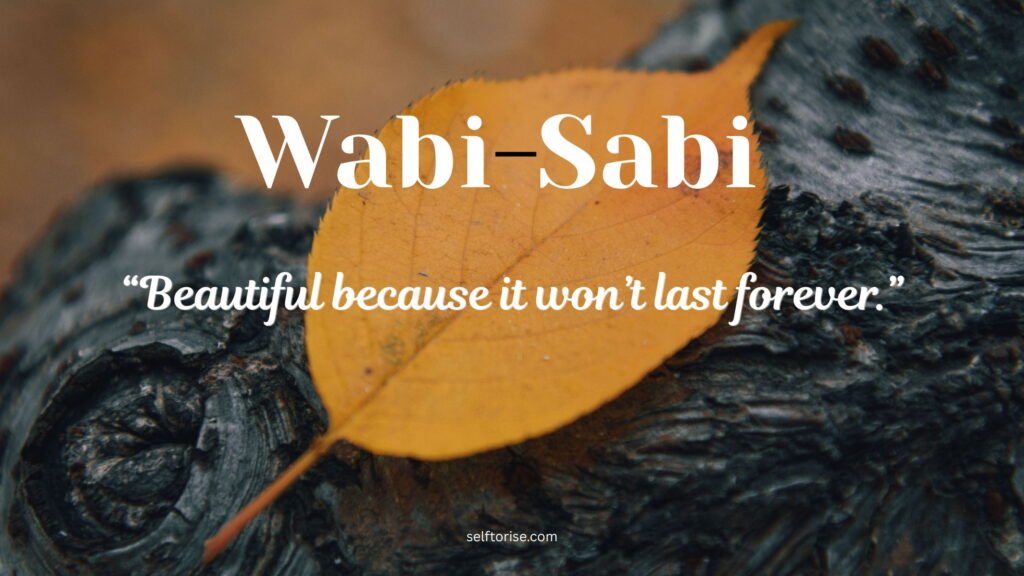
Think about a flower.
You see it blooming beautifully.
But you already know it will not stay that way forever.
The petals will fall.
The leaves will change.
The season will pass.
The flower will disappear.
We don’t usually look at a flower and think, “This is wrong.”
We understand that this is what nature does.
Things grow.
Things change.
Things become old.
Things end.
But when it comes to our own lives, we often struggle to accept the same thing.
We want our relationships to stay the same.
We want our plans to happen exactly as we imagined.
We want people to remain the way they were when we first met them.
We want ourselves to remain the same.
But maybe change is not always something we need to fight.
Maybe change is simply part of life.
Our childhood doesn’t stay forever.
Friendships change.
Our work changes.
People we love grow older.
We grow older too.
We become different versions of ourselves.
And maybe instead of always trying to hold onto what is changing, we can learn to notice it while it is still here.
What is here today may not be here forever.
Maybe that is one reason to appreciate it today.
The Cup of Tea I Almost Missed (Presence & Simplicity)
One day, while I was thinking about Wabi-Sabi, I made myself a cup of tea.
I was sitting beside the window.
The tea was warm.
The air outside was cold.
Everything was quiet.
But my mind wasn’t there.
I was thinking about my future.
What should I do next?
What should I become?
What should I achieve?
What should my life look like five years from now?
I was sitting in the present, but mentally I was already somewhere else.
Then I noticed something.
The moment I was living didn’t need to become anything else.
It was already a moment.
I didn’t need to turn the tea into a productive activity.
I didn’t need to learn something from it.
I didn’t need to make it meaningful.
I could simply drink it.
Feel its warmth.
Notice the cold air.
Look outside the window.
And just be there.
Nothing more.
This small moment made me think about how often we do this in life.
We eat while thinking about tomorrow.
We rest while thinking about work.
We spend time with someone while thinking about what we need to do next.
We keep chasing the next step and forget that the step we are taking right now is also part of our life.
Maybe not every moment needs to lead to a result.
Sometimes we can simply experience it.
The Old Toy I Still Keep (Age, Wear & History)
I have an old childhood toy that is no longer perfect.
It is worn and damaged in some places, but I still keep it.
Why?
Because when I look at it, I don’t only see an old object.
I see a small part of my childhood.
I remember where it came from.
I remember how it made me feel.
Its imperfections are part of its history.
This made me think differently about old things.
An old photograph, notebook, piece of furniture, or handmade object may not look valuable to someone else.
But for us, it can carry a story.
Maybe its value is not in looking new.
Maybe its value is in showing that it has lived.
And then I started thinking about something else.
Just because something has a story doesn’t mean I have to keep it forever.
Sometimes I keep something because it carries a beautiful memory.
But sometimes I keep something because I am afraid to let go.
So I started asking myself:
Why am I keeping this?
Does it bring warmth?
Does it remind me of something meaningful?
Or am I holding onto it because I am afraid of change?
This reminded me of something I had explored earlier through Danshari.
Danshari made me question what I am holding onto and whether I really need it.
Wabi-Sabi made me notice that old and imperfect things can also carry beauty and meaning.
I don’t think these two ideas have to fight each other.
I can appreciate an old object without believing I must possess it forever.
Sometimes I may choose to keep something.
Sometimes I may choose to let it go.
And letting go of an object doesn’t necessarily mean letting go of the memory.
The object can leave while the memory remains.
The Broken Bowl and Kintsugi (Repair & Transformation)
While learning about Wabi-Sabi, I also came across Kintsugi.
You may have seen pictures of broken ceramic bowls repaired with visible lines, often using gold.
What I found interesting was that the repair doesn’t try to hide the break.
The cracks remain visible.
The bowl is not returned to exactly what it was before.
It becomes something different.
Kintsugi is not the same thing as Wabi-Sabi. Kintsugi is a traditional repair technique, while Wabi-Sabi is a broader way of appreciating imperfection, change, age, and simplicity.
But the idea made me think about something.
When something breaks, we often think:
“It’s ruined.”
But is broken always the same as worthless?
Maybe not.
A repaired bowl carries the story of its break.
And perhaps people can be like that too.
We can go through difficult experiences.
We can make mistakes.
We can carry scars from things that happened in our lives.
Those experiences don’t have to become our entire identity.
They can simply become part of our story.
The point isn’t that everything broken must be repaired.
The point is:
Damage does not automatically erase value.
What About Relationships? (Human Imperfection & Change)
I also started thinking about Wabi-Sabi when I thought about relationships.
Every person is imperfect.
We misunderstand people.
We say the wrong thing.
We become emotional.
We make mistakes.
We change.
So why do we sometimes expect relationships to be perfect?
We may expect another person to understand us every time.
We may expect every conversation to go well.
We may expect there to be no disagreements.
But relationships are made of changing human beings.
That doesn’t mean we should accept disrespect, manipulation, or harmful behavior.
But ordinary human imperfection is different.
Two people can misunderstand each other and still care about each other.
A relationship can have difficult days and still contain love.
Someone can make a mistake and still learn from it.
Maybe a good relationship isn’t one that never has problems.
Maybe it is one where imperfect people learn how to handle those problems.
And relationships change too.
The relationship we have today may not be exactly the same as the one we had five years ago.
That doesn’t always mean it became worse.
It may simply mean that it became different.
Accepting My Imperfect Self (Acceptance)
Perhaps the hardest thing for me to accept is not an imperfect object.
It’s myself.
I make mistakes.
Sometimes I start something and stop.
Sometimes I lose consistency.
Sometimes I make decisions that I later regret.
Sometimes I don’t become the person I thought I would become.
And I can be very hard on myself because of these things.
But accepting myself doesn’t mean pretending everything I have done was right.
It means being able to say:
“This happened. I made a mistake. I can learn from it. What can I do now?”
There is a difference between taking responsibility and punishing myself.
I can acknowledge a mistake without making it my permanent identity.
I can improve without hating the person I am today.
I can start again without pretending the previous attempt never happened.
Maybe I don’t need to erase every imperfect part of my past.
Maybe I can understand it.
Learn from it.
And continue.
I Don’t Have to Finish the Journey Today (Incompleteness)
I often think about the person I want to become.
I think about what I should achieve.
What skills I should learn.
What kind of future I should build.
Having goals is important.
But sometimes I become so focused on the finished result that I forget the unfinished life happening in front of me.
I am still learning.
Still changing.
Still making mistakes.
Still discovering what I want.
There is no final version of me waiting somewhere in the future that will suddenly make everything complete.
And maybe that’s okay.
The unfinished journey is still my life.
It is the first video before I become good at making videos.
It is the quiet afternoon.
It is the cup of tea beside the window.
It is the old toy carrying a childhood memory.
It is the repaired object carrying the evidence of its history.
It is the mistake that teaches me something.
It is the relationship that changes over time.
It is the person I am today, who is still becoming someone else.
I don’t have to figure out my entire future today.
I can take the next step.
And while taking that step, I can actually experience where I am.
What Wabi-Sabi Means to Me
The more I think about Wabi-Sabi, the less I see it as a simple rule saying:
“Accept imperfection.”
For me, it feels more like a way of looking at things.
It makes me notice things I might normally ignore.
An uneven object.
A fading flower.
An old house.
A damaged toy.
A quiet cup of tea.
A repaired bowl.
A changing relationship.
An unfinished version of myself.
And each one reminds me of something.
Imperfection reminds me that something doesn’t have to be flawless to have value.
Impermanence reminds me that things change, and temporary things can still be precious.
Simplicity reminds me that an ordinary moment doesn’t need to become an achievement.
Age and wear remind me that time can leave behind character and history.
Repair reminds me that damage doesn’t necessarily erase value.
And acceptance reminds me that I can acknowledge what has happened without constantly fighting against it.
Maybe the flower is beautiful because it doesn’t bloom forever.
Maybe the old toy matters because it carries a story.
Maybe the repaired bowl is meaningful because its history remains visible.
Maybe the cup of tea matters because, for a few minutes, nothing else needed to happen.
And maybe my imperfect beginning is valuable because it is the beginning of something.
Life is not a finished object.
It is changing.
It is aging.
It is breaking and sometimes being repaired.
It is beginning and ending.
It is becoming.
And perhaps I don’t need to remove all of the imperfections before I can see the beauty.
Maybe the beauty was there because of them all along.
Want to explore Wabi-Sabi further?
If this idea interests you, Beth Kempton’s Wabi Sabi: Japanese Wisdom for a Perfectly Imperfect Life is one book you can explore to learn more about the concept and its connection to everyday life.