
Shokunin: The Japanese Mindset That Can Change the Way You Work
Every time I watch an interview with a successful person, I notice something interesting.
Different people have different careers, different stories, and different struggles. But when they talk about their journey, I often hear similar words:
Discipline. Consistency. Dedication. Hard work. Passion.
They talk about doing their work even when nobody is watching. They keep improving even after becoming successful. They don’t allow other people’s opinions to decide whether they should continue.
These ideas made me think about a Japanese concept called Shokunin.
At first, I thought Shokunin was simply about becoming highly skilled at a craft. But the more I learned about it, the more I realized that it can be much deeper than that.
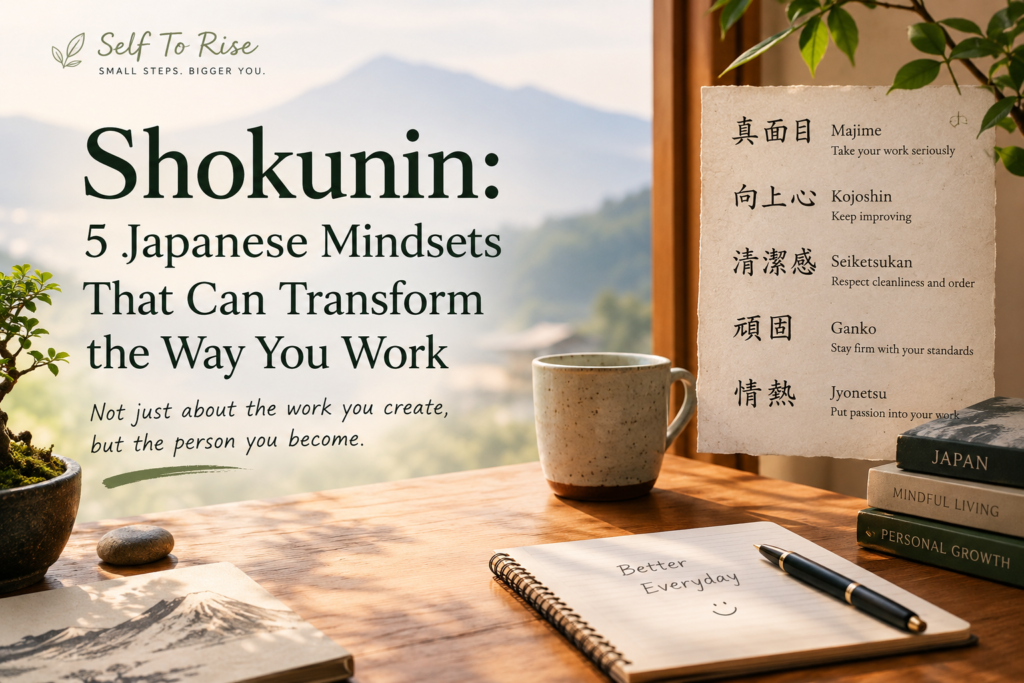
Shokunin is not only about the work you create. It is also about the person you become while doing that work.
And I started thinking: Can I apply this philosophy to my own life?
What Does Shokunin Mean?
Shokunin is often associated with craftsmanship, dedication, and mastery.
A craftsperson doesn’t simply complete a task and move on. They pay attention to small details. They repeat the same process. They learn from mistakes. They keep improving their skills.
But I think the most interesting part is this:
The goal isn’t only to create better work. The process also shapes you.
You become more patient.
More disciplined.
More observant.
More consistent.
And slowly, your work starts reflecting your character.
When I looked deeper into Shokunin, I found five mindsets that made the philosophy feel practical to me.
“To understand the dedication behind Japanese craftsmanship, you can also explore-
1. Majime — Take Your Work Seriously
Majime is about being serious, sincere, and dedicated toward your work.
It doesn’t mean that you have to be serious every minute of your life.
For me, it means that if I choose something, I should give it genuine effort.
I often say that I want to write, learn, build something, or improve myself. But saying it and actually respecting that commitment are two different things.
If I say, “This is important to me,” then my actions should show it.
I don’t need to work for ten hours a day.
Sometimes taking my work seriously can simply mean sitting down and doing the work instead of making another excuse.
Majime reminds me: If something matters to me, I should treat it like it matters.
2. Kojoshin — Keep Improving
Kojoshin is the desire to improve yourself and your work.
This idea immediately reminded me of something I struggle with: wanting to do things perfectly before I even begin.
I sometimes think:
What if my writing isn’t good enough?
What if people don’t like it?
What if I make mistakes?
But Shokunin gives me a different way to look at improvement.
I don’t have to be perfect before I start.
I can start, notice what needs improvement, and become better through practice.
Maybe today’s article is not perfect.
That’s okay.
I can write a better one tomorrow.
Improvement doesn’t require perfection. It requires repetition and attention.
3. Seiketsukan — Respect Cleanliness and Order
Seiketsukan is associated with cleanliness, neatness, and maintaining a clean environment.
At first, this may seem unrelated to personal growth.
But when I thought about my own work, I realized that my surroundings can affect how I work.
When my workspace is messy, my mind can feel distracted too.
Keeping things clean and organized can be a small way of showing respect for my work.
It doesn’t have to become another complicated routine.
It can simply mean:
Clean your workspace.
Keep the things you need ready.
Remove unnecessary distractions.
Create an environment where you can focus.
Sometimes respecting your work begins with respecting the space in which you do it.
4. Ganko — Stay Firm
Ganko is associated with being stubborn or firm.
Usually, we think of stubbornness as something negative.
But there is another kind of stubbornness.
The kind that says:
“I will not give up just because things are difficult.”
This one speaks to me the most.
There have been times when I started something with excitement and then stopped.
I thought about the result.
I worried about what other people would think.
I became impatient when I didn’t see progress.
And eventually, I stopped.
But maybe what I needed wasn’t more motivation.
Maybe I needed to become a little more stubborn about the commitment I had made to myself.
If I decide that something matters to me, I don’t want every bad day to become a reason to quit.
Be flexible with your methods, but firm with your commitment.
“Sometimes, understanding “why people quit their dreams too early” can help us recognize the importance of staying committed.”
5. Jyonetsu — Put Passion Into Your Work
Jyonetsu means passion and enthusiasm.
When we hear the word passion, we often imagine someone who is excited and motivated every day.
But I don’t think passion always looks like excitement.
Sometimes passion looks very ordinary.
It looks like sitting down and doing the same work again.
Practicing when nobody is watching.
Learning when you don’t understand something.
Continuing even when the excitement from the beginning has disappeared.
Real passion may not always feel dramatic.
Sometimes it is simply continuing to care about something.
And I think that’s something worth remembering.
What Shokunin Taught Me About My Own Life
When I put these five mindsets together, Shokunin started to feel less like a philosophy for artists or craftspeople and more like a philosophy for everyday life.
Majime — Take your work seriously.
Kojoshin — Keep improving.
Seiketsukan — Respect your environment and your work.
Ganko — Stay firm when things become difficult.
Jyonetsu — Put your heart into what you do.
None of these ideas say that I need to become perfect.
Instead, they remind me to show up, pay attention, improve, and continue.
And that is something I want to practice in my own life.
Shokunin Is Not About Becoming Perfect
One thing I don’t want to misunderstand about Shokunin is that it means chasing perfection.
For me, it means something different.
It means caring about what I do.
It means trying to do it a little better.
It means respecting the process instead of thinking only about the result.
And most importantly, it means understanding that the work is also working on me.
Every time I write, I am not only creating an article.
I am becoming a better writer.
Every time I continue despite wanting to quit, I am building consistency.
Every time I learn from a mistake, I am becoming more aware.
The work and the person doing the work grow together.
Final Thought
Maybe success is not one big moment when everything finally becomes perfect.
Maybe it is hidden in the small things we do repeatedly.
The article we write.
The skill we practice.
The mistake we learn from.
The day we continue even when we don’t feel motivated.
Shokunin made me think about success differently.
The masterpiece is not only what we create. It is also who we become while creating it.
And perhaps the real question is not:
“How successful will I become?”
But:
“Who am I becoming through the work I choose to do every day?”

This is such a powerful and inspiring perspective on the Shokunin philosophy! What resonated with me the most is the idea that we are not only improving our work, but also shaping who we become through the process. The five mindsets are a beautiful reminder that success isn’t about perfection; it’s about discipline, consistency, patience, and passion. “The masterpiece is not only what we create, but also who we become while creating it.” That message truly hits home. Thank you for sharing such valuable insights!
Thank you for your valuable response.