
Shoshin: The Beginner’s Mind and the Power of Staying Curious
Have you ever started something new and felt completely curious about it?
When I begin something new, I usually have many questions.
I want to know how it works. I want to understand every small detail. I search, experiment, make mistakes, and keep trying.
There is a certain excitement in not knowing.
But after some time, something changes.
The thing that once felt interesting starts feeling familiar. I ask fewer questions. I stop noticing small details. Sometimes I even become bored and eventually stop doing it.
Recently, while learning about Japanese principles, I came across a word that made me look at this pattern differently:
Shoshin.
It means “beginner’s mind.”
At first, I thought it simply meant being curious when you are learning something for the first time.
But the more I researched it, the more I realized that Shoshin is not really about being a beginner.
It is about how we approach something—even after we are no longer a beginner.
And then I realized something:
I had already experienced this in my own journey without knowing there was a word for it.
What Is Shoshin?
Shoshin (初心) is a Zen concept commonly translated as “beginner’s mind.”
It describes approaching something with openness, eagerness, curiosity, and fewer preconceived ideas—even when you already have knowledge or experience.
This sounds simple.
But think about how difficult it can be.
When we know something for the first time, our mind is naturally open.
We ask:
Why?
How?
What happens if I try this?
Is there another way?
But as we gain experience, our mind can start saying:
“I already know this.”
And that sentence can quietly close the door to learning.
Zen teacher Shunryu Suzuki expressed this through the idea that the beginner’s mind contains many possibilities, while the mind that considers itself an expert can become more limited.
The point is not that knowledge is bad.
Knowledge is valuable.
Experience is valuable.
The problem begins when our experience turns into certainty that leaves no room for curiosity.
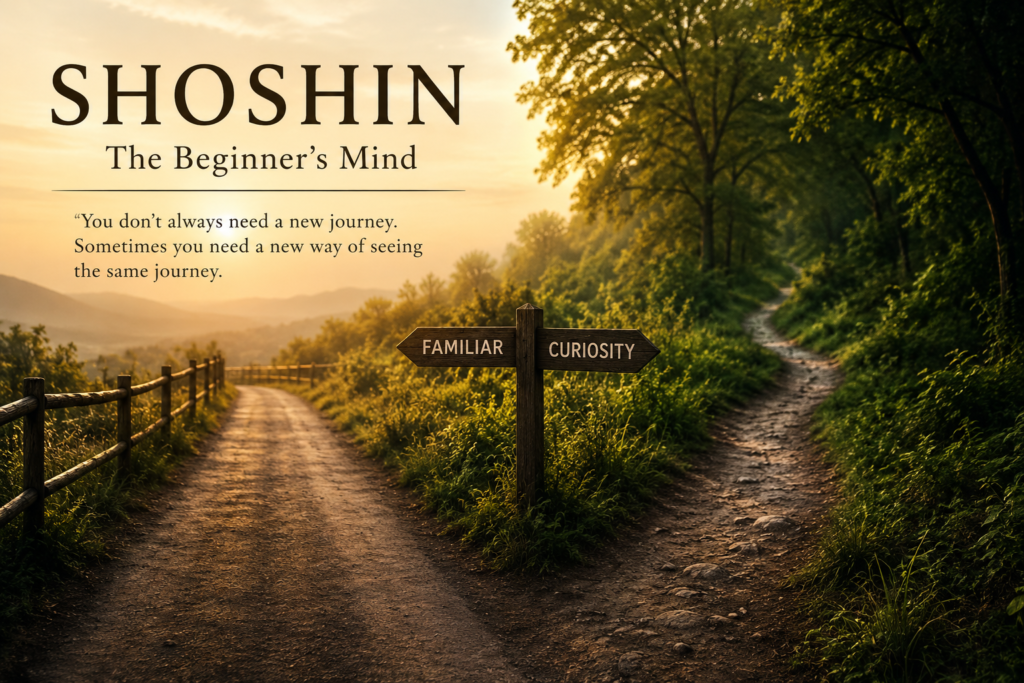
I Experienced This Three Years Ago
A few years ago, I started learning digital marketing.
In the beginning, I was genuinely curious about everything.
I wanted to understand how digital marketing worked.
I explored different topics. I searched for information on social media. I experimented with different ideas. I learned about websites, content, marketing, and many other parts of the digital world.
During that journey, I also started blogging.
At the beginning, everything felt new.
I was excited about building my website. I wanted to make it better. I wanted to write articles. I kept learning and experimenting.
And slowly, something interesting happened.
I started getting traffic.
That should have made me even more excited.
But instead, after doing the same kind of work again and again, I started feeling bored.
What had once been exciting became familiar.
I began looking at the work differently.
Instead of thinking:
“What can I learn from this?”
I started feeling:
“I already know how this works.”
Eventually, I stopped blogging.
At that time, I didn’t think about it as a problem with my mindset.
I simply thought I had lost interest.
But now, after learning about Shoshin, I see that experience differently.
Three Years Later, I Started Again
After about three years, I came back to writing.
This time, something felt different.
I was still working on websites and articles, but my mindset had changed.
I started learning again.
And surprisingly, I was enjoying it.
Every time I worked on an article, I found something new to learn.
I explored new ideas.
I questioned things again.
I experimented again.
I made mistakes again.
I became curious again.
The work itself had not completely changed.
My approach to the work had changed.
Three years earlier, I had started as a beginner and naturally had a beginner’s mind.
When I returned, I had more experience than before.
But because I looked at the process as something new again, I became curious once more.
And this time, I wasn’t trying to prove that I already knew enough.
I was enjoying the process of discovering what I didn’t know.
That experience made Shoshin feel very real to me.
I now confidently believe that this way of approaching my work can help me achieve something meaningful in my journey—not because it guarantees success, but because it keeps me willing to learn, experiment, improve, and continue.
Maybe the Problem Wasn’t the Work
Looking back, I sometimes wonder:
Did I actually become bored with blogging?
Or did I become bored with the way I was approaching it?
There is a difference.
When we start something, almost everything gives us a reason to be curious.
But once we become familiar with it, we may stop looking closely.
We stop asking questions.
We stop experimenting.
We stop noticing small improvements.
And eventually, something that once gave us energy starts feeling repetitive.
Maybe the problem isn’t always the activity.
Sometimes it is the mind we bring to the activity.
My experience taught me that when I approach the same kind of work with curiosity again, it can feel completely different.
You Don’t Have to Know the Word Shoshin to Experience It
Imagine a child seeing rain for the first time.
The child might ask:
Why does water fall from the sky?
Where does the rain come from?
Why does the ground become wet?
Can I touch it?
The child doesn’t know anything about Zen.
The child probably doesn’t know the word Shoshin either.
Yet there is something in that attitude that resembles beginner’s mind: openness, curiosity, and a willingness to discover instead of assuming.
This made me realize something.
We may not need to learn how to become curious.
We may simply need to notice when we have stopped being curious.
We experience this beginner-like state when we start a new hobby, travel somewhere unfamiliar, learn a new skill, meet someone who makes us curious, or look at something familiar from a completely different perspective.
Shoshin gives us a name for that quality of mind.
The Problem With “I Already Know”
Think about something you have done hundreds of times.
Maybe you cook the same meal.
Walk the same road.
Talk to the same person.
Do the same job.
Practice the same skill.
At some point, your brain becomes efficient.
You don’t need to think about every little thing anymore.
That is useful.
But there is another side to familiarity.
We may stop seeing.
We see what we expect to see.
We hear what we expect to hear.
We interpret things according to what we already believe.
Our experience becomes a filter.
Shoshin asks us to loosen that filter.
Not to forget everything we know.
Not to become ignorant again.
But to leave enough space in our mind to say:
“Maybe there is still something here that I haven’t noticed.”
That is very different from pretending we know nothing.
Shoshin Does Not Mean Starting From Zero
This is an important distinction.
Having a beginner’s mind doesn’t mean throwing away your experience.
An experienced person can still have Shoshin.
In fact, that is where the idea becomes most powerful.
A beginner naturally has many things to discover because they don’t know much yet.
But an experienced person has to consciously avoid allowing knowledge to become a closed door.
You can know something and still remain curious about it.
You can be experienced and still ask questions.
You can repeat the same practice and still notice something new.
You can fail and still approach the next attempt with curiosity instead of assuming the next result will be exactly the same.
That is the Shoshin I am beginning to understand.
Every Attempt Can Teach Us Something New
Imagine trying something and failing.
We can think:
“It didn’t work.”
And stop.
Or we can ask:
“What did this attempt teach me?”
Then the next attempt is no longer exactly the same attempt.
We carry something from the previous experience.
We change something.
We notice something.
We try again.
The result may still not be what we wanted, but our relationship with the experience has changed.
This is where beginner’s mind becomes useful.
Instead of approaching the next attempt with:
“I know how this will go.”
we can approach it with:
“Let’s see what happens this time.”
That small difference can change the way we learn.
How Can We Practice Shoshin in Everyday Life?
We don’t have to completely change our lives to practice beginner’s mind.
We can begin with small things.
1. Replace “I know” with “What else can I learn?”
When you hear something familiar, pause before dismissing it.
Maybe there is another perspective.
2. Ask questions again
Sometimes we stop asking questions because we think we already know the answer.
Ask anyway.
3. Look at familiar things differently
Take the same walk, but pay attention to something you normally ignore.
Talk to someone you know and listen without preparing your response.
Return to a skill you have practiced before and notice what you do differently now.
4. Treat mistakes as information
Instead of asking only:
“Why did I fail?”
also ask:
“What did this attempt show me?”
5. Stay curious after becoming comfortable
This may be the hardest one.
The beginning of something is naturally exciting.
But Shoshin asks us to bring some of that openness into the middle—and even the ordinary parts—of the journey.
Maybe We Don’t Need a New Mind
The more I think about Shoshin, the less I see it as something we need to acquire.
Maybe we already know this state.
We experience it when we are genuinely curious.
When we don’t assume.
When we are willing to ask.
When we are willing to learn.
When we look at something familiar and suddenly notice something we had never seen before.
My own journey with digital marketing and blogging helped me understand this.
Three years ago, I was curious because everything was new.
Then familiarity took over, and I stopped.
Three years later, I returned with a different attitude.
I didn’t need the work to become completely new.
I needed to become curious about it again.
And that changed how I experienced the journey.
Maybe growing up doesn’t mean losing our beginner’s mind.
Maybe growing up means learning how to return to it consciously.
Because we will always know more tomorrow than we know today.
And there will always be something we haven’t noticed yet.
So the next time I catch myself thinking,
“I already know this,”
I want to pause.
Maybe instead I can ask:
“What if I looked at it once more with a beginner’s mind?”
Perhaps that is Shoshin—not becoming a beginner again, but keeping enough openness to discover something new even when we are no longer one.
Also Read :-
Want to explore Shoshin more deeply?
Zen teacher Shunryu Suzuki described beginner’s mind as a state that remains open to possibilities rather than being limited by the habits of an expert. The San Francisco Zen Center explains Suzuki’s teaching on beginner’s mind