
How to Become 1% Better Every Day With the Kaizen Philosophy
You don’t need to change your entire life in one day. You just need to take one small step in the right direction.
1. The Person Who Wanted to Change Everything
Imagine a person who wakes up every morning with big dreams.
They want to become financially independent, learn new skills, improve their health, read more books, and become a better version of themselves.
Every Sunday, they create a perfect plan for the coming week. They promise to wake up early, exercise for an hour, read twenty pages, learn a new skill, and work toward their dreams.
For the first two days, everything goes well. They feel motivated and believe their life is finally changing.
But then life happens.
They wake up late one morning. The next day, they feel tired. Soon, they miss their routine completely. Within a week, the beautiful plan they created becomes another unfinished promise.
The following Sunday, they repeat the same process.
Months pass, but their life remains almost the same.
One day, they ask themselves a simple question:
“What if I stopped trying to change my entire life at once and started changing just one small thing every day?”
Instead of reading twenty pages, they read two. Instead of exercising for an hour, they walk for five minutes. Instead of trying to master an entire skill, they practise it for ten minutes.
These actions seem too small to make a difference.
But something begins to change. They become more consistent. They start trusting their promises to themselves. Small actions become habits, and those habits gradually produce meaningful results.
Their life doesn’t transform overnight. It changes through hundreds of small decisions.
This is the idea behind Kaizen.
The story is illustrative, but the lesson is practical: sometimes, the problem isn’t that we lack ambition. It’s that we expect ourselves to make enormous changes before we’ve learned to maintain small ones.
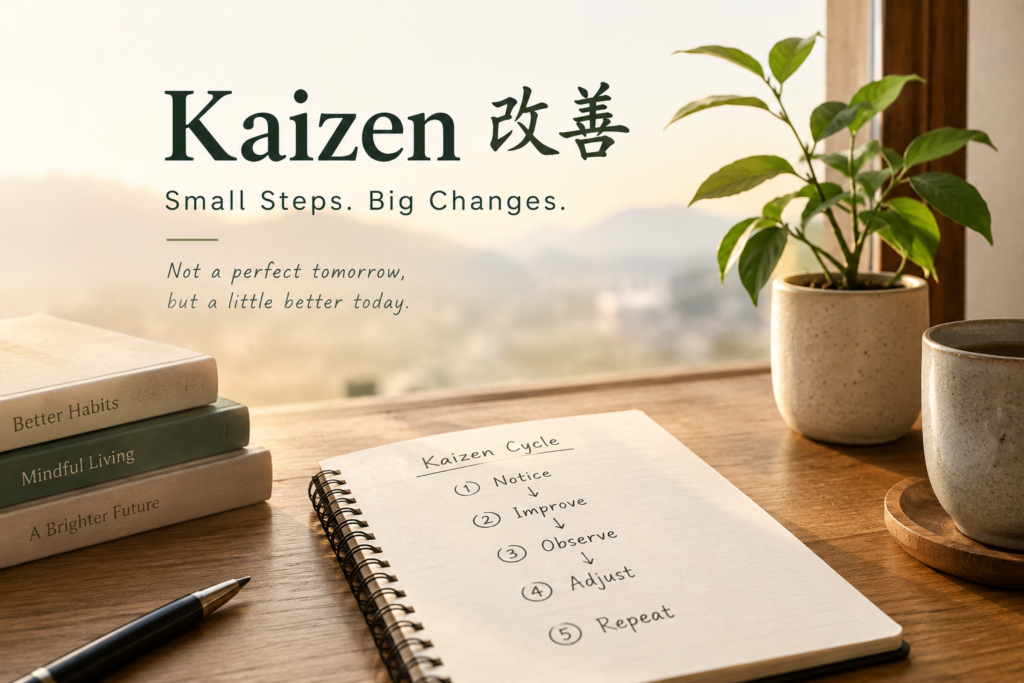
2. What Does Kaizen Mean?
Kaizen is a Japanese concept that means continuous improvement.
The word combines two Japanese elements: kai, meaning change, and zen, meaning good. It is commonly understood as improvement for the better.
Kaizen became widely known through Japanese manufacturing and management practices, where businesses used systematic, ongoing improvements to make their work safer, more efficient, and more reliable.
But the underlying idea can also be applied to personal development.
You don’t have to become perfect today. You don’t have to solve every problem at once. You simply need to identify something you can improve and take a small, meaningful step toward it.
For example:
- If you want to read more, start with two pages a day.
- If you want to learn a skill, practise for ten minutes.
- If you want to save money, track one expense today.
- If you want to become healthier, take a short walk.
- If you want to improve your writing, write one paragraph.
These actions may look insignificant when considered individually. Their value comes from repetition, learning, and gradual improvement.
Kaizen is not about doing the bare minimum forever. It is about creating a starting point you can sustain, then improving your approach as you learn.
3. How Does Kaizen Relate to Our Lives?
Think about how we usually approach our dreams.
We want to earn more money, so we expect to become successful quickly. We want to improve our knowledge, so we plan to read several books. We want to start a blog, so we imagine publishing dozens of perfect articles.
We focus so much on the final destination that we forget to appreciate the process of getting there.
Kaizen encourages us to look at our lives differently.
Instead of asking, “How can I change everything?”, we can ask, “What is one thing I can improve today?”
Imagine that you want to become a blogger.
You don’t need to know everything about blogging before you begin. Today, you can learn how to write a better introduction. Tomorrow, you can study how to choose a useful topic. The next day, you can improve your headline.
Over time, you can learn about search intent, content quality, website structure, and audience needs.
Each small improvement contributes to your development.
The same principle applies to relationships, health, money, communication, and emotional well-being.
You can become a better listener by paying closer attention. You can become more disciplined by keeping one small promise to yourself. You can become more knowledgeable by spending a little time learning every day.
Your life is not shaped only by the big decisions you make. It is also shaped by the small actions you repeat.
4. Why Is Kaizen Important?
It makes change less overwhelming
Large goals can feel frightening because we see the distance between our current situation and the person we want to become.
Small steps reduce that distance into manageable actions.
You may not be ready to write a complete article today, but you can write its outline. You may not be ready to build a business, but you can research one customer problem.
Starting becomes easier when the first step is realistic.
It builds consistency
Motivation comes and goes. Some days we feel energetic; on other days, even simple tasks seem difficult.
A small routine can be easier to maintain during those difficult days.
Consistency doesn’t mean you will never miss a day. It means you learn to return to the process instead of abandoning your goal whenever you make a mistake.
It teaches us to value progress over perfection
Perfectionism often convinces us that we must be completely ready before we begin.
We wait for the right time, the right knowledge, the right tools, or the perfect plan.
Kaizen reminds us that improvement often begins with an imperfect first attempt.
You can write a rough draft and improve it later. You can learn a skill while still being a beginner. You can start with limited resources and upgrade your approach when necessary.
It helps us learn from mistakes
A mistake does not have to become a reason to quit.
Instead, ask what went wrong and what you can change next time.
If you cannot maintain a one-hour routine, perhaps ten minutes is a better starting point. If readers leave your article quickly, perhaps your introduction needs improvement.
Every result gives you information you can use.
It creates a healthier relationship with success
When we measure success only through major achievements, we may feel unsuccessful for long periods.
Kaizen allows us to recognise smaller forms of progress: learning something new, overcoming hesitation, completing a task, or improving a habit.
These small wins matter, even though they do not guarantee a particular outcome.
5. References and the Origin of Kaizen
Kaizen is more than a motivational slogan. It has a history in Japanese business and management.
Kaizen in Japanese manufacturing
After the Second World War, Japanese manufacturers developed and refined approaches to quality and productivity that emphasised systematic improvement. Kaizen became especially associated with the Toyota Production System, where employees were encouraged to identify problems and improve work processes.
The idea was not simply to work harder. It was to look carefully at the way work was done and make it better.
Masaaki Imai and the spread of Kaizen
In 1986, Masaaki Imai published Kaizen: The Key to Japan’s Competitive Success. His work helped introduce the concept to a wider international audience, particularly in business management.
Imai emphasised continuous improvement involving people throughout an organisation, rather than relying only on occasional major changes.
How to use this reference in personal life
A useful lesson from these management practices is that improvement works best when we examine our process.
If you want to become a better writer, don’t simply tell yourself to work harder. Examine how you choose topics, research, structure articles, write, edit, and learn from feedback.
- The Journey of Kaizen Institute- An official history from the organization Imai founded in 1985, detailing how his 1986 book introduced continuous improvement to Western companies.
- What is working?
- What is creating unnecessary difficulty?
- What small change could make the process better?
Kaizen originated as a broader improvement philosophy, not a rule that every person must improve by exactly 1% daily. The popular idea of becoming 1% better every day is a helpful personal-development illustration, rather than a precise historical definition of Kaizen.
6. What Did I Learn From Kaizen?
The most important lesson I take from Kaizen is that I don’t have to become a completely different person to begin changing my life.
For a long time, it can be tempting to believe that success requires a dramatic transformation.
We imagine that one day we will become extremely disciplined, incredibly knowledgeable, financially successful, and confident enough to pursue every dream.
But who we become is also influenced by what we practise today.
I have learned that small actions are not necessarily small in their long-term significance. Writing one paragraph may not make me a successful blogger, but it helps me practise writing. Learning one new concept may not make me an expert, but it adds to my understanding.
I have also learned that improvement is not always about adding more.
Sometimes, it means removing distractions, simplifying a routine, asking for feedback, or finding a better way to do something.
The goal is not to make every day extraordinary.
The goal is to make ordinary days useful.
7. How Did I Learn From It?
I learned to look at progress as a process rather than a single achievement.
Whenever I think about a large goal, I can break it down into smaller questions.
If I want to become a better writer, what can I practise today?
If I want to earn money through blogging, what do I need to learn next?
If I want to understand myself better, what can I reflect on for ten minutes?
These questions turn distant dreams into practical actions.
I also learned that reflection matters. Doing the same thing repeatedly does not automatically guarantee improvement. We need to notice our results, learn from feedback, and adjust our approach.
A small action followed by reflection can be more valuable than repeating an ineffective action without thinking.
That is how I understand Kaizen: take action, observe what happens, learn from the experience, and make the next attempt a little better.
8. My Past Regret and Experience
One regret I can recognise in myself is the tendency to spend too much time thinking about what I want to achieve and not enough time taking the first step.
Sometimes, we become so interested in learning, planning, and exploring possibilities that we forget to put our knowledge into practice.
We search for better methods. We compare different options. We wait until we feel confident enough to begin.
Meanwhile, time keeps moving.
Looking back, I can see the value of starting before everything feels perfect.
I don’t need to know every aspect of blogging before publishing my first useful article. I don’t need to understand an entire subject before practising one part of it. I don’t need to have my entire future figured out before taking a step toward it.
If I could change one thing, I would spend less time waiting for the perfect beginning and more time learning through actual experience.
This does not mean planning is useless. Planning is important, but it should help us take action rather than become a substitute for it.
The past cannot be changed, but the way I use today is still within my influence.
And perhaps the most useful question is not, “How much time have I wasted?”
It is, “What small action can I take now so that I don’t repeat the same pattern tomorrow?”
9. How I Will Apply Kaizen in My Daily Life
I want to apply Kaizen by making improvement a part of my ordinary routine instead of treating personal growth as a temporary project.
Here is how I can begin.
For my blogging journey: I will spend at least fifteen minutes writing, researching, or improving an article. I will focus on one specific skill at a time instead of trying to master everything together.
For my learning: I will choose one useful concept, study it, and write down what I understood in my own words.
For my health: I will begin with a manageable amount of movement and increase it gradually when appropriate.
For my finances: I will learn to understand my spending, develop useful earning skills, and make thoughtful decisions rather than expecting instant financial success.
For my personal growth: I will spend five minutes reflecting on my day. I will ask what went well, what could be improved, and what I want to try differently tomorrow.
Most importantly, I will allow myself to have imperfect days.
If I miss a day, I will return to my routine. If a method doesn’t work, I will adjust it. If progress is slower than expected, I will examine my approach instead of automatically concluding that I am incapable.
I don’t need to improve every part of my life simultaneously.
I can choose one area, establish a manageable routine, and build from there.
10. The 10-Minute Improvement Rule
You don’t need to wait for Monday, the beginning of a new month, or the perfect moment to practise Kaizen.
Try this simple exercise for the next seven days.
Step 1: Choose one area of your life
Choose just one area you genuinely want to improve.
It could be your health, writing, learning, finances, relationships, or confidence.
Step 2: Identify one small action
Choose an action you can complete in ten minutes or less.
For example:
- Blogging: Write one paragraph.
- Reading: Read two pages.
- Learning: Practise one small skill.
- Health: Take a short walk.
- Self-awareness: Write down your thoughts.
- Finances: Record today’s expenses.
Make the action specific enough that you know exactly when you have completed it.
Step 3: Do it every day for seven days
Don’t focus on achieving a dramatic result in one week.
Focus on showing up, learning about yourself, and making the action easier to repeat.
If you miss a day, don’t punish yourself or abandon the experiment. Resume the next day.
Step 4: Reflect for two minutes
At the end of each day, ask yourself:
- What did I do today?
- What made it easier or more difficult?
- What can I improve tomorrow?
Write down one short answer.
Step 5: Improve the process
After seven days, review your experience.
Was the action realistic? Did you learn something? Is there a small adjustment that would help?
If the routine was too difficult, make it smaller. If it felt manageable, continue or increase it gradually.
The purpose is not to follow a rigid rule. It is to discover a way of improving that fits your real life.
Your seven-day challenge: Choose one small action and complete it today. Don’t wait until you feel completely ready.
Final Thoughts: Your Future Is Built in Small Steps
We often underestimate small beginnings because we cannot immediately see their results.
But every skill starts with a beginner. Every meaningful project starts with an idea. Every lasting routine begins with a single action.
Kaizen teaches us to stop waiting for a dramatic transformation and start participating in our own improvement.
You may not be able to change your entire life today. You may not know exactly where your journey will lead. But you can choose one useful action and take responsibility for the next step.
You don’t need to win every day. You need to keep learning, keep adjusting, and keep moving forward.
You don’t have to change your whole life in one day. Just make today a little better than yesterday, and let those small improvements shape the person you become.