
Why Finding Your Ikigai Can Change the Way You Live Your Life
1. Are We Really Living?
Imagine waking up every morning, getting ready for work, completing your daily tasks, coming home, having dinner, and going to sleep. The next morning, you wake up and repeat the same routine.
Days turn into weeks, weeks turn into months, and months turn into years.
We spend our lives studying, working, earning money, fulfilling responsibilities, and preparing for the future.
When we are children, we study to get good marks. As we grow older, we start thinking about our careers, income, and dreams. Later, we may focus on our families, financial security, and responsibilities.
There is nothing wrong with these things. They are important parts of life.
But sometimes, while doing everything we are supposed to do, we forget to ask ourselves a simple question:
What makes me excited to wake up and live another day?
Are we living only to complete our daily tasks, or do we have something meaningful that gives us a reason to keep moving forward?
Perhaps we don’t need to escape our responsibilities. Perhaps we need something that makes those responsibilities feel meaningful.
This is where I started exploring the Japanese concept of Ikigai.
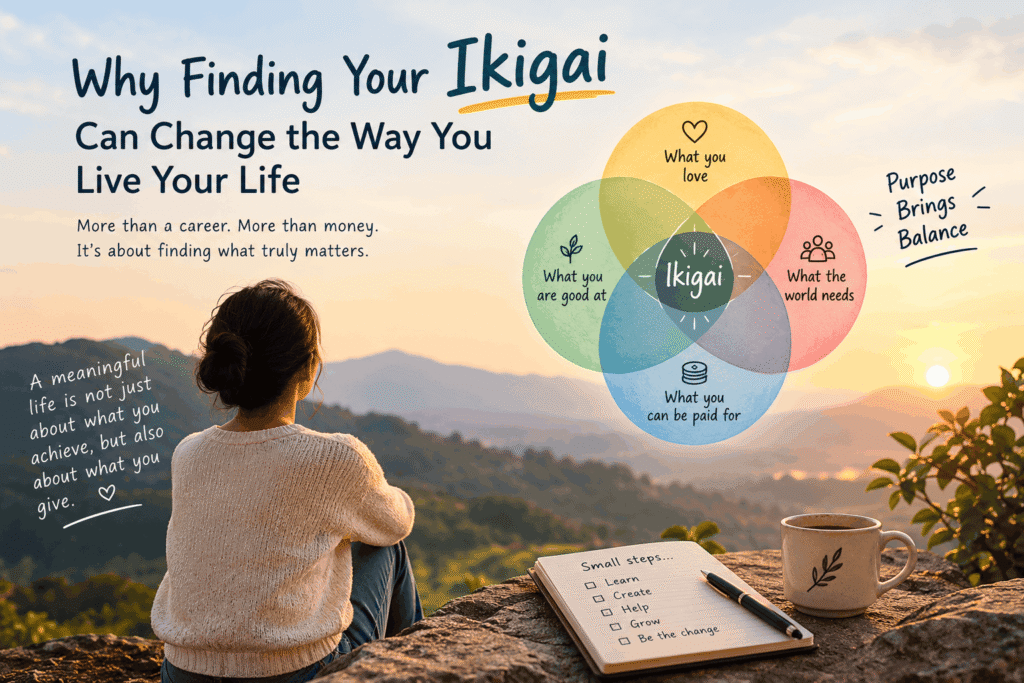
2. What Is Ikigai?
In simple words, Ikigai means a reason for living or something that makes life feel worthwhile.
It can be a dream you want to achieve, a person you want to care for, something you want to create, or even the small things that make your everyday life meaningful.
Ikigai doesn’t have to be a big achievement. It doesn’t mean everyone must discover a mission that changes the world.
It can come from:
- Building a career you care about.
- Creating something of your own.
- Taking care of your parents.
- Raising your children to become strong and independent.
- Helping people who need support.
- Enjoying the simple moments of everyday life.
These are different things, but each can give a person a reason to value their life.
In my understanding, Ikigai is about discovering what makes our lives meaningful and gives us a reason to keep moving forward.
This is my personal interpretation of the concept, based on how I see purpose in our everyday lives. Ikigai has a broader meaning in Japanese culture, and different people may understand and experience it differently.
3. Is Purpose Only About Career?
I believe career is an important part of our lives, but it is not our entire life.
Our daily work influences how we spend our time, the people we meet, our surroundings, and the person we become.
For many people, their career is an important purpose.
Someone wants to earn more money and give their family a better life. Someone wants to build a business and create their own identity. Someone wants to become a writer, an artist, or an expert in their field.
These ambitions can give people direction and excitement.
But what happens when we achieve our dreams?
Imagine someone who spends years building a successful business. They finally have the money, recognition, and freedom they once wanted.
Does their purpose end there?
Maybe they discover a new purpose.
They may want to take better care of their parents, raise their children well, help people in need, or share their knowledge with others.
Their career may have been one important part of their journey, but it doesn’t have to be the only meaningful part of their life.
Similarly, someone who hasn’t achieved their career dreams can still find meaning in relationships, learning, creativity, and helping others.
Perhaps our purpose is not only about what we want to achieve for ourselves, but also about what we want to contribute through our lives.
Our purposes can be different. They can also change as we grow, experience new things, and understand ourselves better.
4. A Childhood Memory That Changed My Understanding
When I was in fourth standard, I used to attend coaching classes for my studies.
The woman who taught us was a retired schoolteacher. What I remember about her is that she taught some students without charging any fees. She also provided study materials to students who couldn’t afford them.
At that age, I didn’t really understand why she did these things. I was a child, and I simply thought of her as a teacher who helped us study.
But now, when I think about those memories, I see them differently.
Perhaps she had already spent years building her career, taking care of her family, fulfilling her responsibilities, and raising her children to become strong and independent individuals.
Maybe, after those stages of life, she found another way to make her time meaningful: helping children get an education.
Of course, I cannot know exactly what she was thinking. But her actions made me reflect on an important question.
What if earning money is not the only reason we work, and achieving our dreams is not the only purpose we can have in life?
Perhaps she found meaning in helping children who needed support. By teaching them without fees and providing study materials, she helped make education more accessible to them.
She may not have received money for every lesson she taught, but her actions had value beyond money.
When I was a child, I didn’t fully understand the meaning of her actions. Today, those memories help me see that a person’s purpose can extend beyond their career, income, and personal achievements.
Sometimes, our purpose is not about what more we can gain from life. It is about what we can give to it.
This is one way I understand Ikigai through my own experience.
5. Why Does Having a Purpose Matter?
Having a purpose can change how we approach our everyday lives.
It doesn’t mean we will always feel motivated or that our problems will disappear. It means we have something meaningful that can guide our efforts.
It gives us direction
When we know what matters to us, we have a clearer reason to decide where to spend our time and energy.
It gives our efforts meaning
Working towards something we care about can make difficult days feel more worthwhile.
It helps us look beyond routine
Our responsibilities remain important, but we also make room for our dreams, relationships, interests, and personal growth.
It reminds us that success is personal
One person may want wealth, another may want to create something extraordinary, and someone else may want to give their family a peaceful life.
We don’t all need the same definition of success.
It allows us to grow
Our purpose can change as our circumstances and priorities change. Achieving one dream doesn’t mean we have nothing left to live for.
Purpose is not a guarantee of happiness, but it can help us live more intentionally.
6. What Does Ikigai Teach Me?
My biggest learning from Ikigai is that life doesn’t have to revolve around one achievement.
We can have ambitions, work hard, build careers, and earn money. There is nothing wrong with wanting a better life.
But we can also find meaning in the people we care for, the knowledge we share, the things we create, and the help we offer to others.
My retired teacher’s example made me think about how purpose can extend beyond professional success.
Perhaps she found satisfaction in helping children learn. Perhaps she wanted to give something back to her community. I don’t know her exact reason, but I can see the value of what she did.
It made me realize that we don’t always need to do something extraordinary to make our lives meaningful.
Sometimes, helping one person can matter.
Sometimes, raising a child with love and care can matter.
Sometimes, creating something we believe in can matter.
And sometimes, simply enjoying the life we have built can matter.
I am learning that I don’t need to know the purpose of my entire life today.
Instead, I can ask myself:
- What matters to me right now?
- What do I want to work towards?
- What kind of person do I want to become?
- How can I make a positive difference in my own life or someone else’s?
I may discover new answers as I grow, and that is okay.
7. How Can We Find Our Own Ikigai?
We don’t need to change our entire lives in one day. We can begin by paying attention to what matters to us.
Here are four simple steps.
Step 1: Notice what matters
Think about the activities, people, and experiences that make you feel interested, connected, or fulfilled.
It might be writing, learning, creating, caring for your family, or helping others.
Step 2: Choose something meaningful
Ask yourself what you would like to build, learn, experience, or contribute.
Your goal doesn’t need to impress anyone else. It needs to matter to you.
Step 3: Take small actions
If you want to become a writer, write regularly. If you want to help others, start with a small act of kindness. If you want to build a career, begin developing the skills you need.
A meaningful direction becomes more real when you take steps towards it.
Step 4: Stay open to change
What matters to you today may not be exactly what matters to you ten years from now.
You may achieve a dream, develop a new interest, or discover a different responsibility that becomes important to you.
You don’t have to find one purpose and follow it forever.
You can continue discovering what makes your life worthwhile.
8. Conclusion: Give Your Life a Reason to Move Forward
We spend much of our lives preparing for the future. We study, work, earn money, fulfil responsibilities, and try to build a better life.
But while preparing for tomorrow, we should not forget to ask what makes today meaningful.
For some people, it may be a career. For others, it may be family, creativity, helping others, or the freedom to live according to their values.
And for many of us, it may be a combination of these things.
My childhood teacher helped me see this in a new way. I may never know exactly why she chose to teach children without charging them, but her actions remind me that a person’s contribution can extend beyond earning money or achieving personal success.
Perhaps Ikigai is not about finding one perfect answer to the meaning of life.
Perhaps it is about paying attention to the things that make life worth living and finding ways to give those things a place in our everyday lives.
We don’t have to wait until we achieve every dream to begin living meaningfully.
We can work towards our future, care for the people around us, and appreciate the present at the same time.
Because life is not only about what we achieve. It is also about what gives our lives meaning along the way.
Finding your Ikigai doesn’t mean you need to change your entire life overnight. Sometimes, purpose begins with small actions and gradual improvements. The Japanese concept of Kaizen reminds us that small, consistent steps can lead to meaningful change.
It also helps to accept that life isn’t perfect. Learning about Wabi-sabi can offer another perspective on appreciating imperfection and finding meaning in the life we already have.